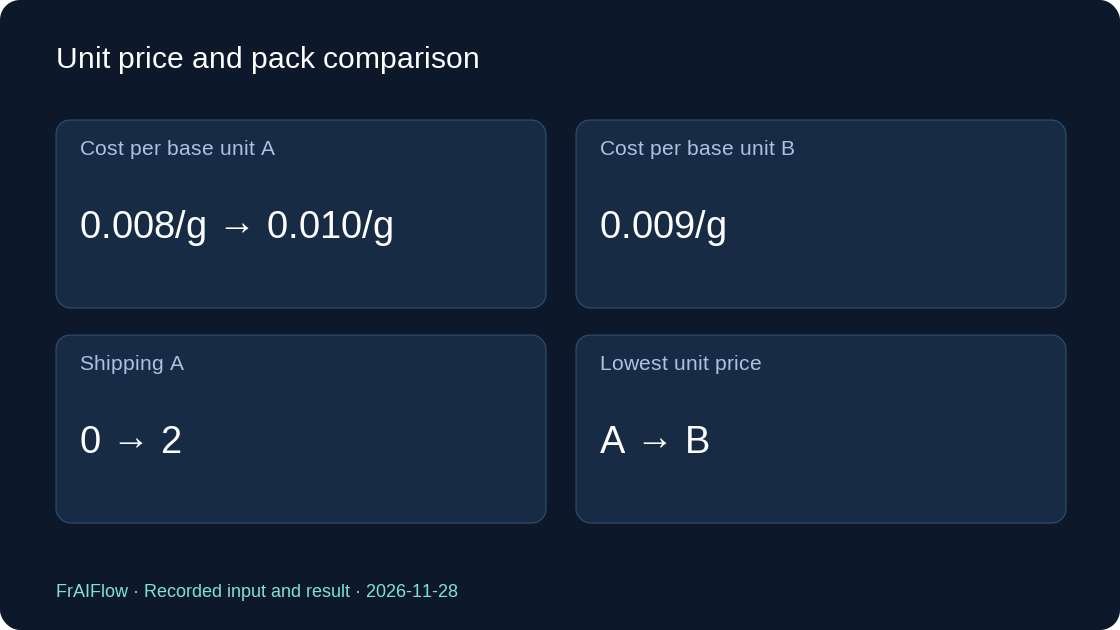
A 20% discount made pack A look cheaper in our test. It contained two 500 g items and cost 10 before discount. Pack B contained 1 kg and cost 9. With free delivery, A cost 8 per kilogram. Adding a shipping charge of 2 changed A to 10 per kilogram, and B became the cheaper option. The product and discount had not changed; the delivered cost had.
Compare the quantity you actually receive
Enter the price for the whole pack, the amount in one item, and the number of items in that pack. Two 500 g bags contain 1,000 g. Entering 1,000 g and a count of two would double the quantity a second time and halve the reported unit price. This is an input mistake that a plausible-looking result will not reveal.
FrAIFlow converts compatible mass units to grams and volume units to millilitres. Items use a count. A litre and a kilogram are not interchangeable without knowing the product’s density, so the calculator rejects that comparison. Keep all prices in the same currency and use the same tax basis.
Change delivery before choosing the winner
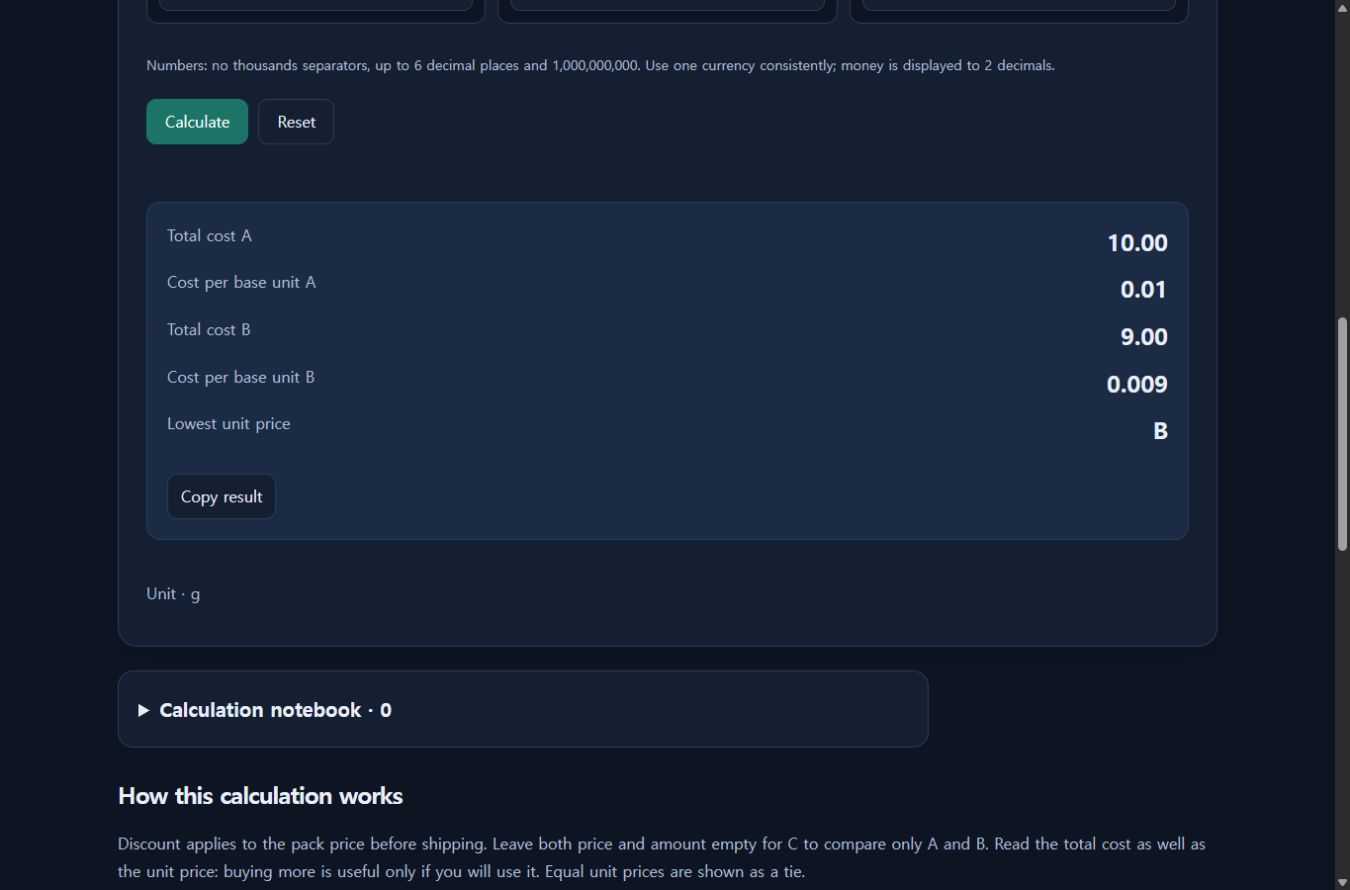
For the published fixture, the calculation is (10 × 0.8 + 2) ÷ (500 × 2) = 0.01 per gram for A. B is 9 ÷ 1,000 = 0.009 per gram. Those are 10 and 9 per kilogram respectively. The discount applies to the pack price; shipping is added afterwards. A delivery charge that is also discounted needs an adjusted input.
We also set A’s shipping to zero and repeated the calculation. A then won at 0.008 per gram. Setting B’s price to 10 with A’s original shipping produced a tie. These are separate test conditions, not prices collected from a shop. The downloadable data keeps each condition distinct.
Use the result without buying more than you need
The lowest unit price answers one question: which offer supplies the cheapest comparable quantity? It does not decide whether the larger purchase fits your budget or whether you will use it before it expires. Check the total payment beside the unit price. Shared delivery for an order needs to be allocated consistently rather than added in full to every item.
Use A and B for two offers; add C when a third pack is relevant. Leave both C’s price and amount blank to omit it. Press Calculate to record a condition, change one cost, and record the next. Comparing those records makes the reason for a changed winner visible. Device saving is optional; export the record if you need a copy outside this browser.
Recorded input and result
| How this calculation works | Reproducible example |
|---|---|
| Pack price A · Amount per item × Items in pack | 10 · 500 g × 2 |
| Discount % A · Shipping A | 20% · 0 → 2 |
| Cost per base unit A | 0.008/g → 0.010/g |
| Cost per base unit B | 0.009/g |
| Lowest unit price | A → B |
Verification and scope
Verified with the current FrAIFlow calculation engine and the browser workflow. Zero quantities, incompatible units and discounts above 100% were rejected. The example uses invented prices and no retailer-specific tax, coupon or delivery rules.
Actual calculator screen · English interface