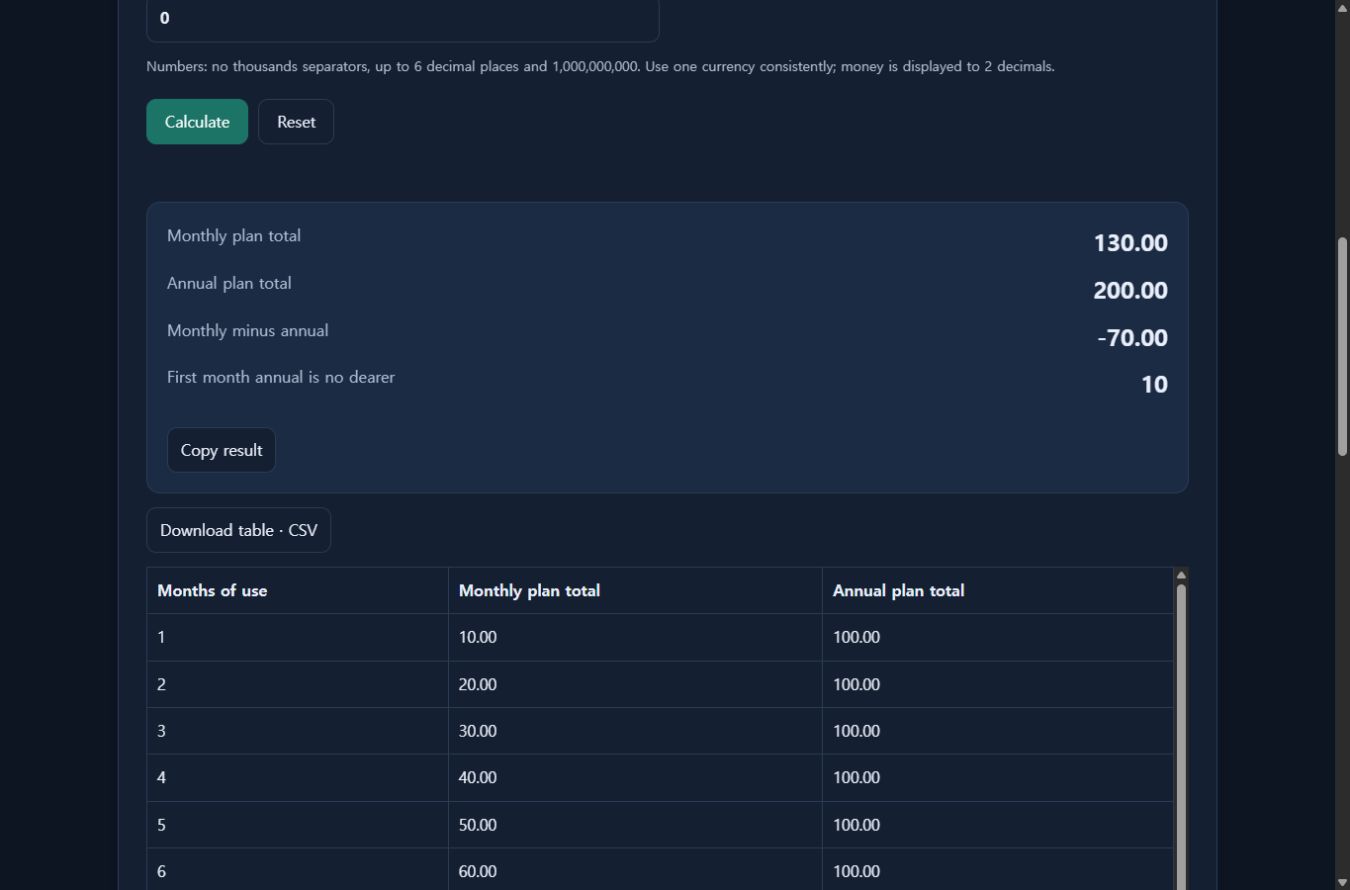
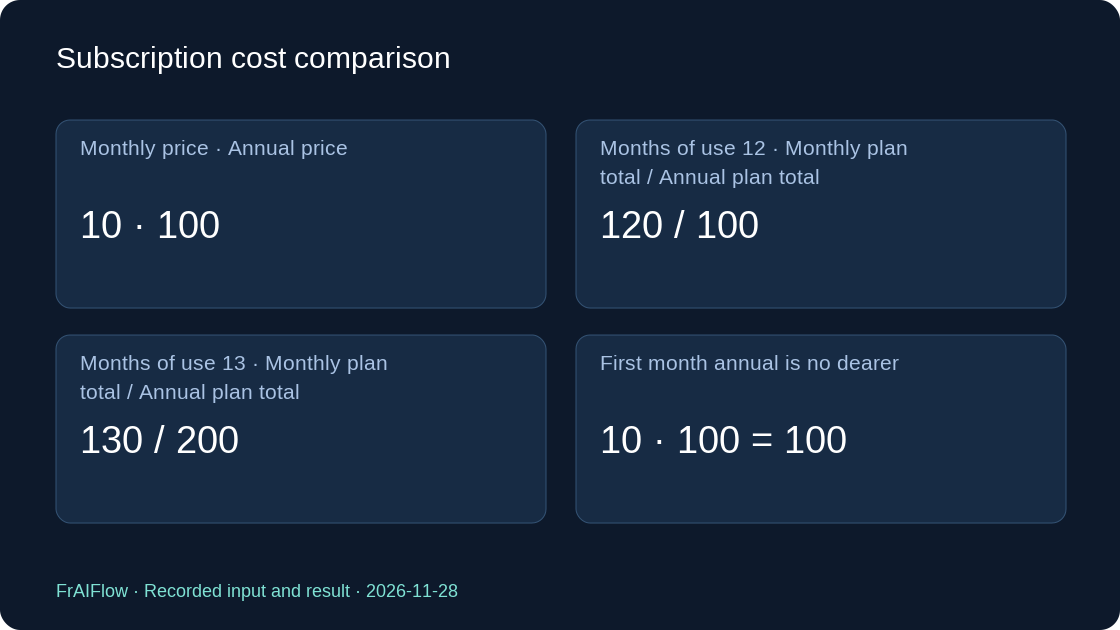
Our test plan cost 10 per month or 100 per year, with no introductory discount or setup charge. At 12 months, the monthly plan had cost 120 and the annual plan 100. At 13 months, the totals became 130 and 200. Starting a second prepaid year changed the answer even though the advertised prices stayed the same.
Choose a payment question before comparing prices
An annual price divided by 12 is a useful monthly equivalent, but it is not the cash charged every month. FrAIFlow compares payments made over the entered period. The annual calculation charges complete 12-month blocks in advance. Month 1 therefore includes 100; month 13 includes a second 100. No unused months are refunded in this example.
For the first year, the annual plan becomes no dearer at month 10: both choices have cost 100. It is cheaper by 20 at month 12. That first crossover is not a promise that the annual plan remains cheaper at every later date. A renewal creates another jump in the payment total.
Include introductory prices and setup charges once
The monthly plan can have an introductory price for a specified number of months. In a second verified condition, we entered 1 for the first two months, then 10 thereafter. Twelve months cost 2 × 1 +10 × 10 =102. The annual plan remained 100. Using 12 × 10 would have hidden most of that promotion’s effect.
Each plan also has its own one-time setup field. It is added once, not at every renewal. Enter all amounts on the same currency and tax basis. A free trial, partial refund, price change or cancellation penalty needs the applicable payment schedule; this model does not fetch a provider’s contract.
Inspect the month where you expect to stop
Read the total for your intended period and the monthly table near each annual boundary. The difference is monthly total minus annual total: a positive result means annual has cost less by that date. A negative result means the monthly choice has cost less. Download the CSV if you want to inspect several stopping dates together.
Record 12 months, then change the horizon to 13 and compare the two records. That is the quickest way to see why a yearly average can be misleading for a short extension. The calculator answers a payment-timing question under entered assumptions. It does not judge the service’s usefulness or predict whether you will continue using it.
Recorded input and result
| How this calculation works | Reproducible example |
|---|---|
| Monthly price · Annual price | 10 · 100 |
| Months of use 12 · Monthly plan total / Annual plan total | 120 / 100 |
| Months of use 13 · Monthly plan total / Annual plan total | 130 / 200 |
| First month annual is no dearer | 10 · 100 = 100 |
| Introductory monthly price 1 × 2 · Months of use 12 | 102 / 100 |
Verification and scope
Verified horizons include 12 and 13 months, the first equal-cost month, and a two-month introductory rate. Annual payments are modeled as nonrefundable prepaid 12-month blocks. Browser CSV export and saved-record restoration were checked.
Actual calculator screen · English interface