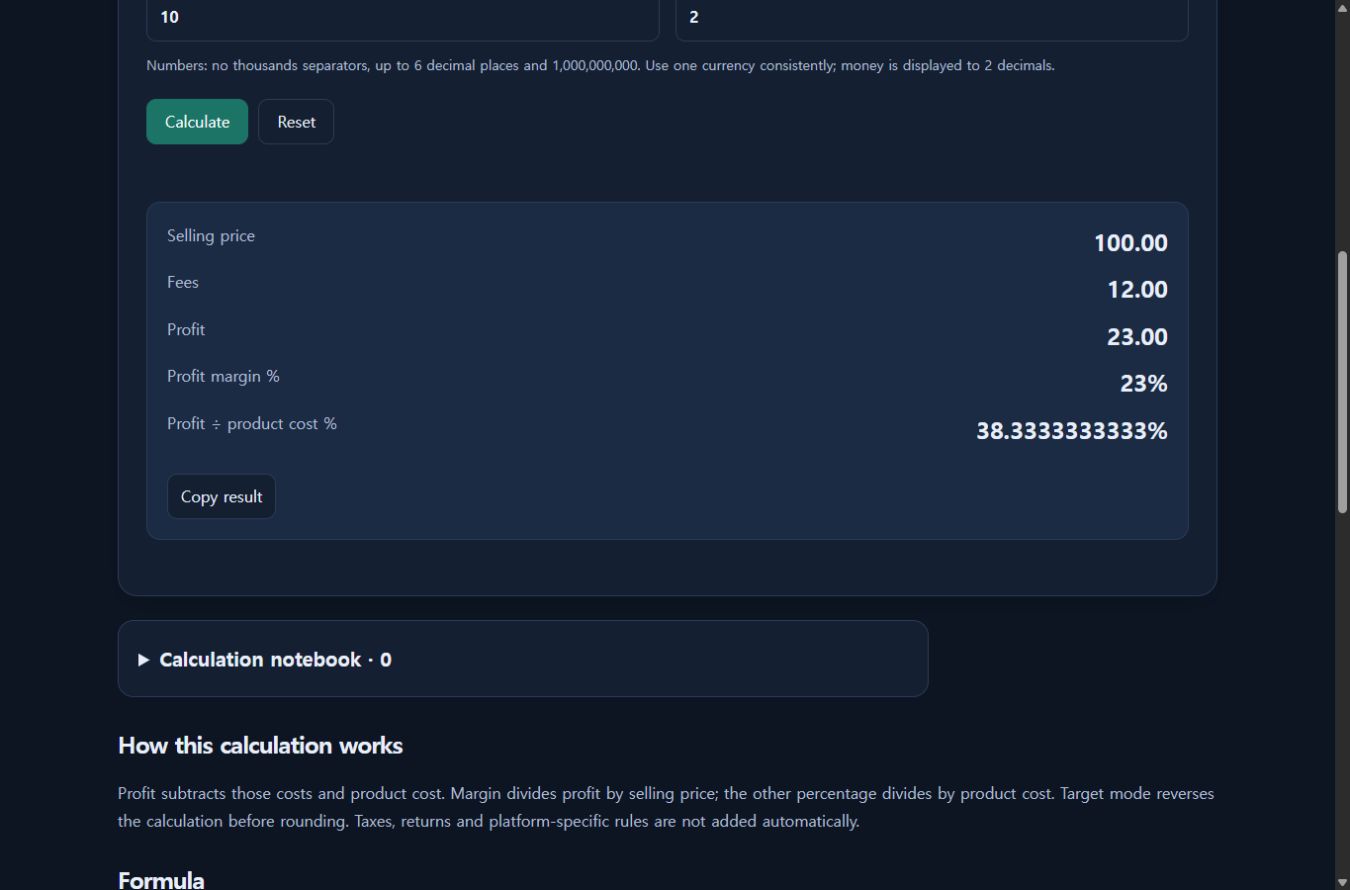
Our test sale had a price of 100, a product cost of 60, shipping of 5, a 10% sales fee and a fixed fee of 2. The amount left was 23. Its margin was 23% of sales, while profit divided by product cost was about 38.33%. Both percentages described the same sale. They differed because they used different denominators.
Put the fee on the correct amount
The percentage fee in this calculator is charged on the entered selling price. At 100, the 10% component is 10; the fixed charge makes total fees 12. Subtract 60 for the product, 5 for shipping and 12 for fees, and the result is 23. Omitting shipping would overstate this example’s profit by 5.
That result is the profit within the costs you supplied. Advertising, returns, packaging, taxes and overhead are absent unless you include them in a suitable input. A marketplace may apply its fee to a different base or round each charge separately. Check its statement before treating this model as a settlement calculation.
Reverse the equation for a target margin
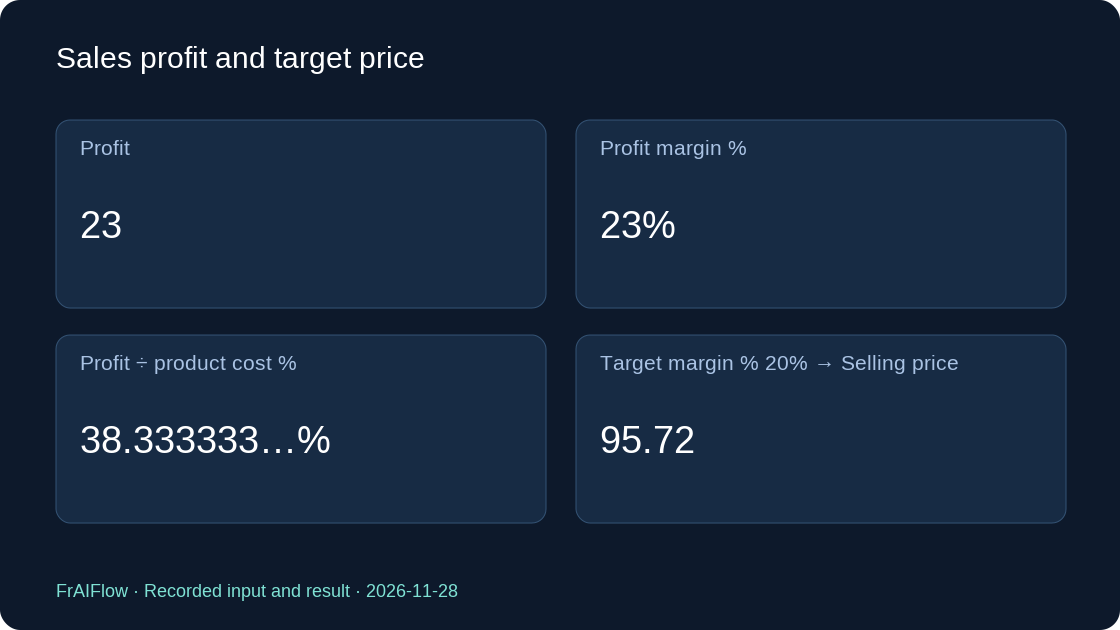
For a 20% target margin with these same costs, the equation is P = (60 + 5 + 2) ÷ (1 − 0.10 − 0.20). It gives approximately 95.7142857. FrAIFlow rounds the target selling price upward to the next 0.01, so the displayed target is 95.72. Rounding down to 95.71 would fall slightly short under this model.
The fee percentage and target margin together must remain below 100%. Otherwise there is no positive share of each sale left to cover those fixed costs. The calculator refuses that condition. It also leaves the product-cost ratio unavailable when product cost is zero rather than dividing by zero.
Keep display rounding separate from the contract
Money is displayed to two decimal places, but the percentage calculation uses the underlying values. At the target price, a percentage fee can contain fractions of a cent before display rounding. A platform that rounds each fee before subtraction may produce a slightly different settlement. The calculator does not select a currency or know its smallest permitted payment unit.
Record the original 100 sale, then choose target-price mode and enter 20. Compare the inputs and results to see what changed. A target price is a condition for this entered cost model, not a prediction of demand or a guarantee of business profit. Recheck costs when delivery charges or fee terms change.
Recorded input and result
| How this calculation works | Reproducible example |
|---|---|
| Selling price | 100 |
| Product cost · Shipping · Fees | 60 · 5 · (10% × 100 + 2) = 12 |
| Profit | 23 |
| Profit margin % | 23% |
| Profit ÷ product cost % | 38.333333…% |
| Target margin % 20% → Selling price | 95.72 |
Verification and scope
Verified with exact decimal arithmetic in the calculator engine and saved browser records. The target-price boundary and zero-cost ratio were checked. No tax, marketplace contract or statutory accounting treatment is assumed.
Actual calculator screen · English interface