
The same local time can mean two different UTC instants
An appointment written as “New York, 1 November 2026, 01:30” leaves a choice unresolved. In our browser test that local time matched two UTC instants an hour apart. We kept the date, source zone and destination unchanged, then selected each occurrence separately to see exactly what changed.
In this article
Reproduce the unresolved time
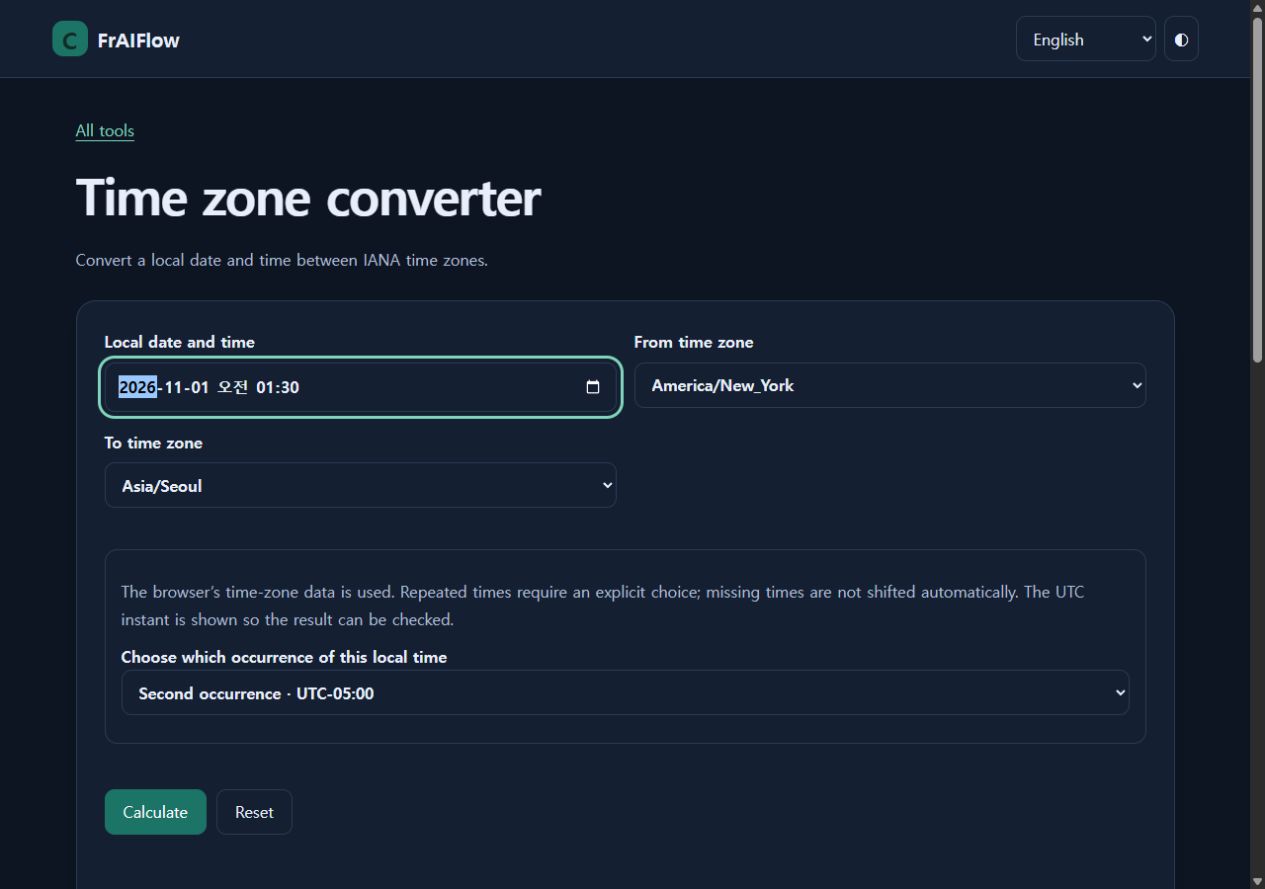
Open the time-zone converter. Enter 2026-11-01 01:30, choose America/New_York as the source and Asia/Seoul as the destination. The converter asks for the intended occurrence instead of selecting one automatically. The clock reading alone does not identify which of the two instants is meant.
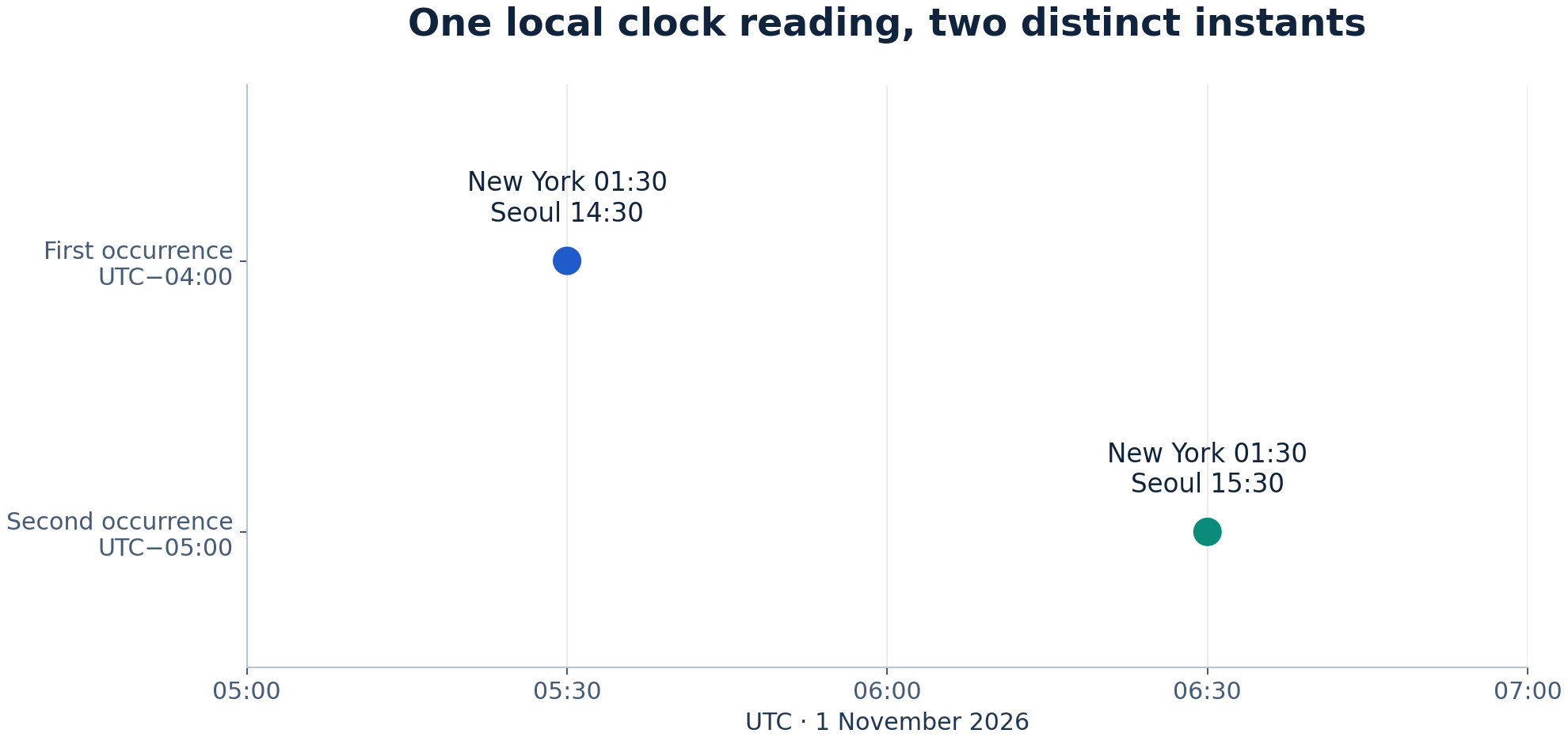
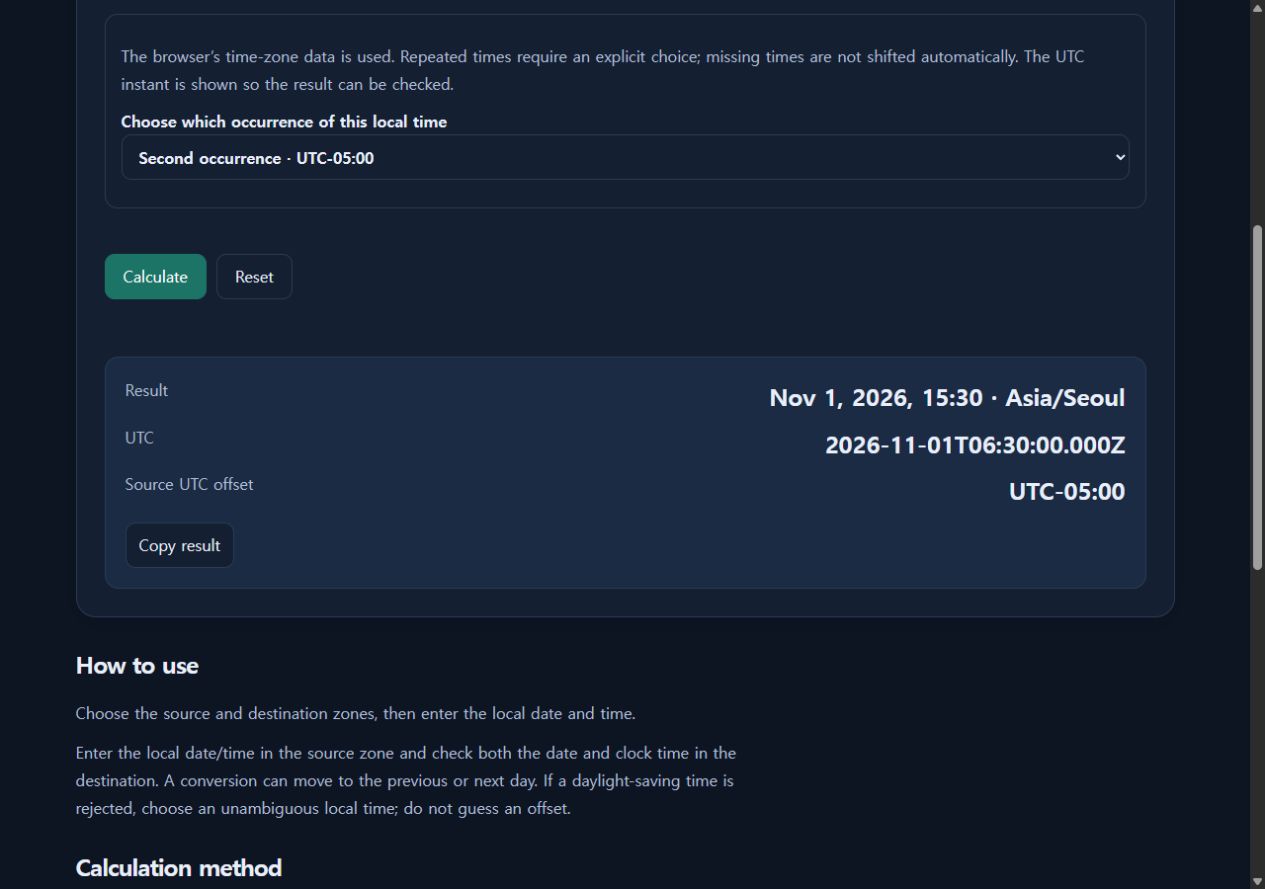
Choose First occurrence. The result is 2026-11-01T05:30:00.000Z, with source offset UTC−04:00, and 14:30 in Seoul. Choose Second occurrence without changing the input. UTC becomes 06:30Z, the offset becomes UTC−05:00, and Seoul becomes 15:30. Both answers correspond to the entered New York clock reading.
Find the missing piece in the original message
For a real appointment, ask for the UTC instant, an explicit offset, or a calendar invitation that identifies the intended occurrence. A fresh conversion cannot infer what the sender meant. Writing only 01:30 again, or replacing the city with a loosely used abbreviation, leaves the uncertainty unresolved.
After choosing, copy the result together with its date and UTC line. In this example, “01:30, America/New_York, second occurrence, 06:30Z” records the decision. Compare the destination date too: other conversions can cross midnight even when this particular one does not.
Handle a missing time differently
We also entered 2026-03-08 02:30 for America/New_York. The converter refused it because that local clock time was skipped when the clock moved forward. There is no First or Second choice to make in this case. Moving it to 03:30 would create a different appointment, so the tool does not do that silently.
Return to the schedule and confirm a valid time with the person who supplied it. A missing time and a repeated time need different decisions: one has no matching instant, while the other has more than one.
Keep the conversion record understandable
These results were recorded on 26 November 2026 using the browser’s time-zone data. The supplied test record contains the input, both offsets, both UTC results and the rejected spring example. It is a controlled conversion test, not evidence that a calendar service or another person accepted an invitation.
The converter supports the zones listed in its menus and dates from 1900 through 2100. Time-zone rules and the data installed in a browser can differ, especially for future dates. For a consequential schedule, retain the explicit instant and confirm the displayed local time in the receiving calendar. Recheck future events if the relevant rules change.
Repeat this conversion
Did this help you solve your problem?
We send your selected answers and page information, never your files or input contents. Feedback is kept for up to 30 days. Privacy